About
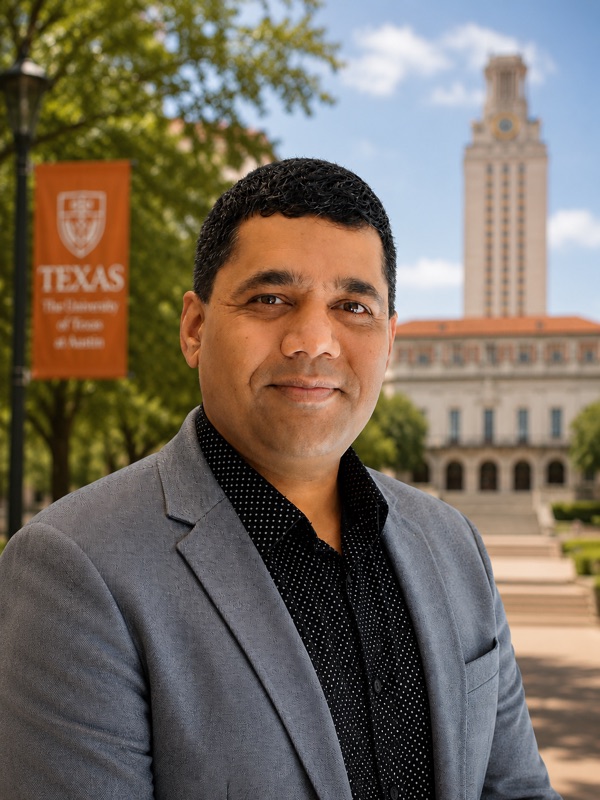
I'm Amol Kelkar - Enterprise AI Architect at Qualtrics (Seattle, WA). Every project here started as something I couldn't stop thinking about. Some grew into companies (Aflatune, Creator Republic, OfficeSpace.com, Got It AI - all acquired). Some became papers - the homeostatic theory of consciousness, Cognitive Homeostatic Agents, the Decision Intelligence formalization. I love to build, and there's a lot of it these days - Karta, the agent call stack, Carapace Intelligence, and many more.
The arc began at UT Austin (1998–2000), modeling large cortical networks with growing self-organizing maps under Risto Miikkulainen and Jim Bednar. Then seven years at Microsoft (2001–2008) on NetDocs, InfoPath, the Office Forms platform, OneNote, and Windows Live - eight US patents come from that era. A stretch of co-founder and CTO roles came next: Aflatune (2008–2010, India's first streaming music service, later acquired), Creator Republic (2010–2011, KingOfTheWeb - a “YouTube with a winner” online reality game; later acquired), Edufied (2011–2013, an ed-tech platform whose products included Ragafied and VideoReadr), and OfficeSpace.com (2013–2017, CTO of the commercial-real-estate B2B platform serving 100K+ business users; later acquired). Then five years at Got It AI (2019–2024) as Co-founder, Chief Scientist, and CTO - leading R&D and product on AutoRAG, TruthChecker (adopted by NVIDIA), AutoFlows, and the patented autonomous conversational AI system, with AI agents deployed to tens of thousands of enterprise users. Acquired by Qualtrics in November 2024. Now at Qualtrics, guiding the agent-native transformation of the company.
Playbooks deserves its own callout. It's one of the first agent harnesses ever built - a pioneering open-source Software 3.0 framework where you write multi-agent systems as plain-English Markdown programs that semantically compile to a low-level assembly executed by LLMs. The stack includes a semantic compiler, runtime engine, hybrid Python interop, MCP-based multi-agent collaboration, a VSCode step-debugger that breakpoints on English instructions, and PlaybooksLM - a 3B-parameter LLM fine-tuned for fast, cheap, accurate execution. Advanced capabilities like runtime program synthesis, verifiability constraints, and multi-agent emergent behavior hint at potential AGI use. Mainstream agent systems are still catching up to a lot of this.
I've always been fascinated by the substrate of biological intelligence and consciousness. What started in 1999 toward a PhD thesis I revisited during a 3-year sabbatical (2017-2020) and have continued investigating through the years. Not actively investigating right now while I focus on agentic AI initiatives, but the computational neuroscience learnings continue to guide me. The artifacts (Cognitive Homeostatic Agents, the homeostatic theory of consciousness, Pattern Machine, nanoGPT experiments, and the hierarchical predictive coding transformer) all live under this thread.
With coding AI agents I'm now building at 1000x my former pace. Rapidly building large-scale projects, loving the process. Right now that means Karta, callstack + unwind, Carapace Intelligence, unfold, a few native macOS apps (CrazyDisk, CrazyWindows), and Harness Programming (a book in progress) - see the full project list (55 entries) and the timeline for the rest.
Selected publications and patents
- Autonomous conversational AI system without any configuration - US Patent 12,282,743, 2025, 26 citations
- Towards automatic evaluation of task-oriented dialogue flows - arXiv:2411.10416, 2024
- KULCQ: An Unsupervised Keyword-based Utterance Level Clustering Quality Metric - arXiv:2411.09853, 2024
- Cognitive Homeostatic Agents - AAMAS 2021, 2021, 5 citations
- Bertrand-DR: Improving Text-to-SQL using a Discriminative Re-ranker - arXiv:2002.00557, 2020, 34 citations
- Scaling self-organizing maps to model large cortical networks - Neuroinformatics 2(3), 2004, 45 citations
- Modeling large cortical networks with growing self-organizing maps - Neurocomputing 44, 2002, 33 citations
Full list on Google Scholar (~485 citations, h-index 12, i10-index 12).
Education
- The University of Texas at Austin (1998–2000) - graduate research on biologically realistic large-scale cortical network models
- University of Pune (1993–1997) - BE Computer Engineering, Summa Cum Laude